Who had it easier when buying a home, baby boomers or millennials? A new report from the US property company Redfin, covered by The MortgagePoint, gives a surprising answer: it depends on when you bought. In this guide we use that story to learn real maths skills: percentages, rates and the formula behind a mortgage.
The news in numbers
Here are the main figures from the report, in plain words.
- An older millennial who bought at age 30 spent about 27% of their income on housing. A boomer at the same age spent about 36%.
- Mortgage rates were very low for about ten years, falling below 3% in 2021. By late 2022 they were close to 7%, after prices had jumped by about 40%.
- A millennial who bought at 40 instead of 30 would spend about 35% of their income on the same kind of home.
- Boomers faced rates above 16% in 1981, but homes were cheaper, and later falling rates let many of them refinance into smaller payments.
- The typical millennial household at 37 earned about $100,000, against $88,000 for boomers at that age.
Every one of those lines is a percentage or a comparison. Let us see how to work with them.
Share of income: the percentage you need
To find what share of your income goes on housing, divide the housing cost by the income, then multiply by 100.
Example. Your income is $5,000 a month and the mortgage payment is $1,500.
1,500 ÷ 5,000 = 0.3, and 0.3 × 100 = 30%. That sits right on the common "30% rule" of thumb.
You can turn it around too. If you want to stay at 30% on a $5,000 income, the most you can pay is 30% of 5,000. Use the percentage of an amount page to check: 0.30 × 5,000 = $1,500.
Comparing incomes. The report says $100,000 against $88,000. The difference is 12,000, and 12,000 ÷ 88,000 is about 0.136. So millennial households earned roughly 13.6% more. The percentage calculator will do this in one go.
A percentage or a percentage point?
The story says rates rose "from about 3% to nearly 7%". There are two correct ways to say how big that rise is, and they sound very different.
- In percentage points: 7 − 3 = 4 percentage points.
- As a percentage change: 4 ÷ 3 ≈ 1.33, so the rate rose by about 133%.
Be careful in exams. If a question says "by how many percentage points", subtract. If it says "by what percentage", divide the change by the starting value.
The mortgage payment formula
A typical mortgage is repaid in equal monthly payments. The payment M comes from this formula:
- P is the amount borrowed.
- i is the interest rate per month: the yearly rate divided by 12.
- n is the number of monthly payments: years × 12.
It looks scary, but it is just three numbers and a calculator. It is closely related to the maths of annuities and loans, and to compound interest, where small percentages grow into big amounts over time.
Worked example: 3% against 7%
Let us borrow $300,000 over 30 years, so n = 30 × 12 = 360.
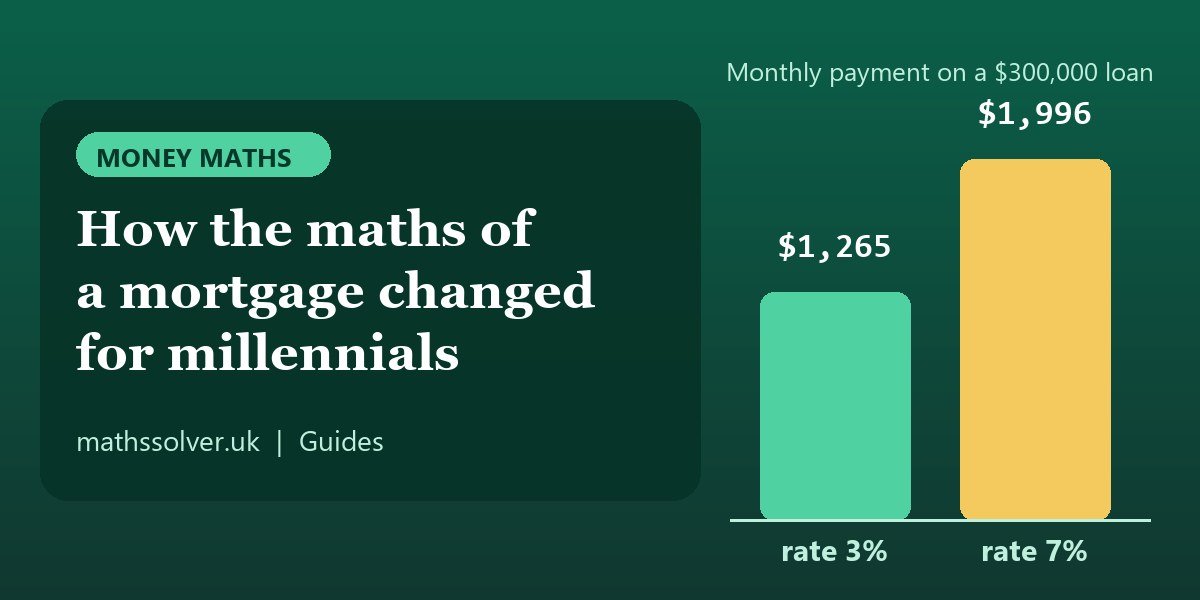
At 3%. i = 0.03 ÷ 12 = 0.0025. Putting this into the formula gives a payment of about $1,264.81 a month.
At 7%. i = 0.07 ÷ 12 ≈ 0.005833. The payment is about $1,995.91 a month.
| 3% rate | 7% rate | |
|---|---|---|
| Monthly payment | $1,264.81 | $1,995.91 |
| Total repaid over 30 years (× 360) | $455,332 | $718,527 |
| Share of a $6,000 monthly income | 21.1% | 33.3% |
Now compare. The monthly payment goes up by 1,995.91 − 1,264.81 = $731.10. As a percentage of the old payment, that is 731.10 ÷ 1,264.81 ≈ 57.8% more. Over 30 years the total repaid rises by about $263,000. The loan amount did not change at all, only the rate.
Why prices and rates both matter
The report says boomers paid high rates but lower prices, and millennials paid higher prices. Two things push a payment up: a bigger loan and a higher rate. In the formula, the payment is directly proportional to P, so a loan that is 40% bigger means a payment that is 40% bigger, if the rate stays the same. That is ratio and proportion at work.
The rate has a bigger, less obvious effect, because it is inside the bracket on the bottom of the formula. That is why going from 3% to 7% had such a large effect even with the loan unchanged.
Falling rates also explain why many boomers saw their housing share fall from over 60% of income in their early twenties to about a quarter by their late thirties. When rates drop, a new loan at the lower rate has a smaller payment for the same amount owed. Redo the calculation with the new i and you can see the saving.
Try it yourself
- A loan of $200,000 over 25 years at 4%. Work out n and i first, then M. Check with the loan and mortgage calculator.
- A household earns $4,200 a month and pays $1,260 on housing. What share of income is that? (Answer: 30%.)
- Rates fall from 7% to 5%. State the change in percentage points and as a percentage.
- If house prices rise by 40% and the loan rises with them, by what factor does the payment change at a fixed rate? (Answer: 1.4.)
For more practice with percentages, try the practice questions or ask the step-by-step solver to show the working.
Frequently asked questions
How do I work out what percentage of my income goes on housing?
Divide the monthly housing cost by your monthly income and multiply by 100. For example, 1,500 divided by 5,000 is 0.3, so 30%.
Why does a small change in the interest rate matter so much?
Interest is charged on the whole loan every month, for many years. A few percentage points can add hundreds to each payment and tens of thousands to the total you repay.
What is the difference between a percentage and a percentage point?
Going from 3% to 7% is a rise of 4 percentage points. As a percentage change it is 4 divided by 3, which is about 133%. Both are correct, but they say different things.
Is the 30% rule a law?
No. It is a rule of thumb that says housing should cost no more than about 30% of income. It is a handy guide, not a promise that a payment is affordable.
Does refinancing really lower a payment?
If rates fall, a new loan at a lower rate has a lower payment for the same amount borrowed. You should also count any fees to see whether it saves money overall.